English
 Español
Steam Hair Straightener Brush Factories: What Buyers Must Verify Before the First Shipment
A steam straightener brush looks simple, but manufacturing one well is not. Buyers who know what to expect from a factory get consistent products; everyone else inherits the returns.
You found a factory that lists a steam hair straightener brush in its range. The price is competitive and customization sounds easy. Then the first batch arrives: some units sputter instead of misting, the temperature display drifts, and retail complaints start within weeks. The problem is rarely the product idea. It is the factory's ability to control steam, heat, and water inside one compact handle.
This guide comes from a manufacturer that builds steam styling appliances for OEM and ODM clients. It covers the technology to expect, the checks that matter in factory qualification, the risks that create the most returns, and the signals that separate a dependable steam straightener brush factory from a trading-style supplier.
Why a Steam Straightener Brush Is Harder to Make Than It Looks
A conventional straightener applies dry heat through flat plates. A straightener brush adds bristle rows so hair slides through with tension and smoothness in one pass. Add steam, and the engineering challenge multiplies. That complexity is why factory selection deserves more time than price negotiation.
Inside a steam straightener brush, a small water chamber feeds a heating element that produces fine mist. The moisture softens the hair cuticle while heated bristles and plates reshape it, often at lower temperatures. Behind that simple description sit four demands: consistent vapor output, leak-proof sealing, mineral-resistant water paths, and stable heating while steam is generated.
Steam delivery that actually works
Ask how the factory controls steam release. Continuous-release systems produce even vapor but use water quickly. On-demand systems are more precise but depend on a reliable pump and valve, often the first parts to fail in low-cost units. A credible factory should explain its tank design, steam path materials, and how it prevents mineral buildup and condensation.
Thermal control matters just as much: plate temperature must stay stable while vapor passes through the same heating zone. PTC elements are economical but less precise; digital temperature control gives the predictable performance professional users expect.
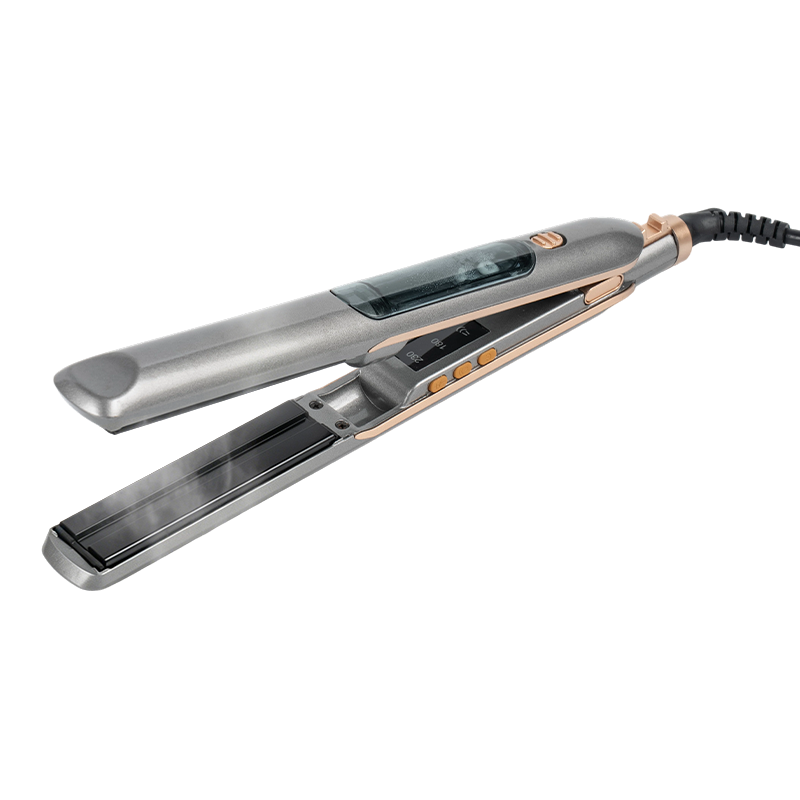
Our nanoscale steam balance straightener is built around that exact relationship between steam output and heating control. When a factory shows you that coordination in its own product line, you are talking to engineers, not just an assembly team.
What to Check When Qualifying a Factory
Buyers usually start with unit price and MOQ. Those matter, but the checks below protect you from the costliest failures in this category.
Steam system integrity
Inspect the tank sealing and vapor channel. Heat-resistant silicone seals and food-grade water-contact materials reduce leakage and odor risk. Ask how water-tightness is tested on the line and whether every unit is checked.
Heating and temperature accuracy
Useful straightening ranges usually span 120 °C to 230 °C. The maximum number matters less than accuracy: about ±5 °C tolerance is reasonable for a mid-range product, while weak designs drift by 15 °C or more. An LCD display helps the user, but the sensor behind it decides whether the display tells the truth.
A realistic spec sheet
Expect a mid-range steam straightener brush to hold a 130–200 °C working range, reach operating temperature in under 60 seconds, and stay within roughly ±5 °C of the set value during a ten-minute continuous use test.
Safety compliance and materials
Certification requirements vary by destination market. Confirm whether the factory can produce units tested against the electrical safety, electromagnetic compatibility, and material restriction standards for your target regions. This is where you should also review how to tell if a hair straightener is safe, because the same warning signs apply at the manufacturing stage.
OEM and ODM depth
A factory's real value appears when you request changes. Can it adjust bristle length, plate width, handle geometry, or tank capacity? Does it offer color injection, spray painting, or water-transfer finishes? A manufacturer with in-house mold development responds with timelines and costs instead of vague promises.
- Steam output test: ask for vapor volume and consistency measurements, not a demo video.
- Thermal calibration: how many temperature points are inspected in final QC?
- Water tank life: clarify capacity and how many uses are expected before cleaning.
- Material documentation: request certificates for heat-resistant plastics and metal parts before mass production.
- Pilot batch: run a small pilot before committing to container quantities.
Steam-Based Styling Tools: Matching the Product Form to Your Market
Factories that list a steam hair straightener brush may produce several related formats. Knowing the differences helps you pick the right SKU for your channel.
| Format | Product form | Best suited for | Key production focus |
|---|---|---|---|
| Steam straightener | Flat plates with steam ports | Classic straightening with added moisture | Plate coating and steam port positioning |
| Steam straightener brush | Bristle rows with steam outlets along the head | Smoothing and detangling while straightening | Bristle heat resistance and even steam distribution |
| Steam spray comb | Comb teeth with atomized mist output | Fluffy volume, root lift, and quick refreshing | Droplet size, tooth spacing, and water tank position |
| Steam conditioning styler | Higher-capacity mist chamber | Deep hydration and water-ion treatment | Ion generation and nozzle sealing |
Our production range covers this spectrum. In the straightener brush category, the MXN301 smart LCD straightener gives buyers a visible temperature readout for precise control, while steam models such as the water-light comb and the nanoscale straightener cover the moisture-focused side of the lineup.
If your retail plan relies on a single SKU, choose the format that matches your customers' existing hair care habits. If you are building a family of products, a factory with multiple steam platforms lets you test the market without switching vendors.
Sourcing Risks in Steam Straightener Brushes — and How to Mitigate Them
The steam category carries risks that dry styling tools do not. Water, pressure, heat, and plastic housings create failures that only appear after weeks of use.
Stop the conversation if
The factory cannot show water-tightness test records, cannot name the safety standards it produces to, or treats steam output as a cosmetic feature instead of a measured performance parameter.
- Inconsistent steam output. If pump or heating coil quality varies, some units mist while others drip. Mitigation: request steam volume records across production batches.
- Tank leakage. Poor seal tolerance shows up during shipping or in humid climates. Mitigation: confirm water-tightness testing is part of final inspection, not just first-article sampling.
- Temperature drift. A unit running 10 °C below the set point creates poor results and high returns. Mitigation: review thermal calibration points in test reports.
- Undeclared certification gaps. Passing one market's tests does not guarantee another's material requirements. Mitigation: agree on target standards in writing before tooling starts.
- Overstated customization. Some suppliers call minor color changes ODM service. Mitigation: confirm mold ownership terms and the engineering change process in advance.
A practical sourcing rule
Ask for a sealed sample, run it through 100 heating and steaming cycles, and measure the temperature at the first, fiftieth, and hundredth cycles. The difference between those three measurements tells you more about the factory than any brochure.
Our steam aqua atomized styling comb is manufactured with the same water-path sealing discipline we apply across the steam lineup. Compare it side by side with samples from other suppliers, and the differences in nozzle behavior and temperature stability become visible quickly.
What a Reliable Factory Partnership Looks Like
Manufacturers can publish impressive capability lists. Behaviors are more telling. Look for a factory that treats steam technology as a core competence rather than an accessory.
At Cixi Ya Yi Electrical Appliance Co., Ltd., the steam family is organized into dedicated lines for nanoscale steam straighteners, steam spray fluffies, and steam water-light combs, because each form factor demands different engineering. A factory that structures its catalog this way usually has the research, mold shop, and testing capacity to back it up.
"The best OEM and ODM partners do not just accept a spec sheet. They ask what behavior you expect from the product, then translate that into steam rates, heating curves, and quality checks before they quote a price."
Ten years of industry experience, more than ten patents, and long-term clients in more than fifteen countries are the milestones we report. The takeaway for buyers is simpler: choose a partner that can name its technologies, show its factory, and define its testing process without hesitation.
Three questions for the first call
- Which of your steam devices has been through the most revisions, and what did each revision fix?
- Can you provide a temperature calibration report from final quality control?
- What is your standard sampling plan for water-tightness and steam output?
The outcome to aim for
A sealed sample that passes repeated heating and steaming cycles, a documented quality control plan, and a factory that answers technical questions with numbers — those three signals justify moving to pilot production.
Steam hair straightener brush factories are not interchangeable. The difference sits in steam-system engineering, temperature accuracy, safety testing, and the willingness to prove both claims and process. When a factory answers your questions with data instead of adjectives, it has earned a pilot order.