English
 Español
Steam Styling Field Notes
Steam Hair Straightener Reviews: What the Star Ratings Do Not Tell You
Forty reviews can describe how a styler behaves on real hair. They rarely explain why, or whether the next thousand units will behave the same way.
Someone reads forty reviews of a $79 steam straightener, counts the phrase "one pass and done" eleven times, and adds it to the cart. A product manager at a salon brand reads the same forty reviews and sees a different object: a particular combination of plate temperature, steam volume and nozzle geometry that produced those eleven sentences, plus a question about whether that combination survives a five-thousand-unit order. Both readers are correct. Only one is reading at a scale that protects the purchase.
This page is about the second reading: what steam hair straightener reviews genuinely measure, which phrases map onto which internal parts, and the specifications worth agreeing on before a single sample is approved.
Why Steam Reviews Read Differently From Dry-Iron Reviews
A dry straightener is judged on heat alone: how hot, how fast, how evenly. A steam styler adds moisture, and moisture changes the physics of the pass. A thin film of vapour between the plates conducts heat into the strand more evenly and cuts friction, so the same smoothing result arrives at a lower plate temperature, in fewer passes, with less of the sizzle that reviewers associate with damage.
That is why the language in these reviews clusters so tightly. Praise repeats: fewer passes, less frizz on day two, no burnt-hair smell, shine that outlasts the first hour. Complaints repeat just as predictably: spitting, dripping, a tank that empties mid-section, a unit that performs well for three months and then fades.
None of that reveals what sits underneath. Whether the plate still holds 185 °C while it pulls moisture out of wet hair, whether the nozzle was machined inside tolerance, whether the tank seal still seals after two hundred heat cycles — a five-star write-up cannot show any of it, and all of it decides what the two-hundredth review of your own product will say.
"Two passes, and my ends still looked like ends. No steam cloud, no hissing, no smell of hot metal."A recurring sentence in verified five-star steam styler reviews, paraphrased
Four Review Signals Worth Counting
Sorting reviews by star rating is the least efficient way to read them. Sorting by theme is more useful, because themes repeat across brands, price points and hair types.
| Review theme | What it usually points to | What to verify |
|---|---|---|
| "One pass and done" | Stable plate temperature combined with controlled steam output | Temperature recovery after a wet pass, held within ±5 °C of the set point |
| "It spits water" | Nozzle tolerance, tank seal, vent placement | Nozzle dimension tolerance near ±0.05 mm and a 45° tilt test at a full tank |
| "The tank runs dry" | A small reservoir paired with a high steam rate | Reservoir volume of 8–15 ml and a documented refill interval every three to five passes |
| "Great at first, weaker later" | Mineral scale building up inside the atomizing path | Whether distilled water is specified and whether the tank can be removed and rinsed |
| "Too hot near the scalp" | Housing and tip insulation rather than plate temperature | Handle surface below 60 °C after thirty minutes at the highest setting |
The third column never appears on a review page. It comes from a factory, a measurement or a teardown, which is exactly why it is worth extracting before a purchase decision is made.
How Steam Reaches the Hair, and Why It Changes the Review
Steam stylers are not one category. Three delivery formats dominate, and each one produces a different kind of feedback.
Vented plates
Vapour leaves the heating surface through small openings along the plate. Reviewers describe an even glide and short passes; complaints cluster around sputtering, which usually traces back to an overfilled tank, a tilted unit, or a nozzle that drifted outside tolerance.
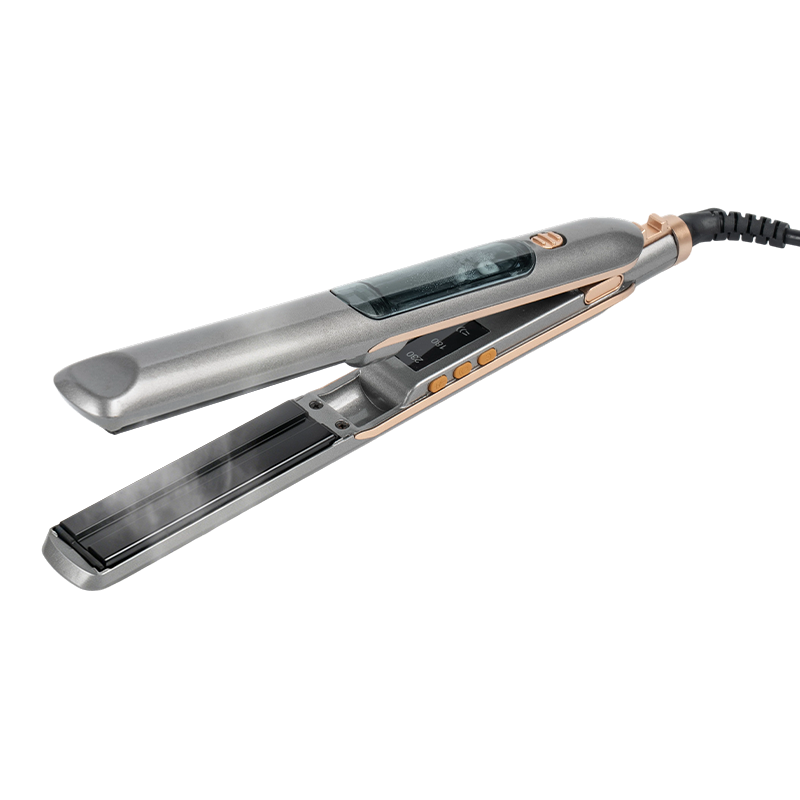
The engineering goal here is not maximum steam. It is steam matched to the rate at which the plates can drive it into the strand, which is the idea behind the MXN302 nano-scale steam balance straightener. Too much vapour cools the plate and forces a second pass; too little, and the user is simply holding an ordinary iron in a heavier housing.
Mist ahead of the plates
A fine spray wets the section an instant before the plates close. Reviews of this format describe a damp-set feel in the first hour and a style that holds its shape well, although over-spraying is the most common user error and shows up as a complaint rather than a feature.
Steam combs and brush stylers
Vapour travels through a comb body instead of across a flat plate. The vocabulary shifts: reviewers talk about roots, lift and volume far more than sleekness, and judge the tool by day two rather than hour one.
The Claims Most Reviews Cannot Test
"Hydrating", "less heat damage" and "water-ion conditioning" are measurable claims, just not by someone standing at a bathroom mirror. Reviews can describe how hair looked an hour later. They cannot show moisture regain on a tress, fibre surface temperature, or tensile strength after fifty cycles. When a claim carries your positioning, ask for the test method and the sample size behind it.
Warning
Tap water is the most common cause of long-term steam styler failure. Minerals deposit inside the micro-nozzle, output drops, and what looks like a manufacturing defect becomes a warranty dispute. Distilled water only belongs on the label, in the manual and in the store listing.
Serviceability decides how manageable that warning is. A reservoir and atomizing path that can be removed and rinsed turns a one-year product into a three-year product, and the difference shows up in reviews written eighteen months after purchase — the ones that quietly set a product's reputation.
The MXN303 steam atomizing water-ion hair conditioner sits in this spray-and-condition branch of the category, where the atomizing head carries most of the maintenance burden.
The Spec Sheet That Answers the Reviews
If review themes are the demand side of the market, a specification is the answer to them. These points are worth agreeing on before tooling, sampling and the first production run.
- Temperature accuracy, not temperature range. A stated span of 150–230 °C says little; plate surface measured by contact thermocouple within ±5 °C of the set point says a great deal.
- Temperature recovery. How many seconds the plate needs to return to its set point after a wet pass at full steam.
- Steam output. Expressed in grams per minute with a tolerance band, rather than described as strong or gentle.
- Reservoir. Volume in millilitres, refill interval in passes, seal material and the number of open-close cycles that seal survives.
- Nozzle discipline. A dimension tolerance around ±0.05 mm plus a full flow-and-leak test before assembly.
- Surface temperatures. Handle and tip below 60 °C after thirty minutes of continuous use, with automatic shut-off after fifteen to thirty minutes.
- Cycle testing. Five hundred heat cycles, five hundred steam cycles and a drop test on the packed unit.
- Market compliance. Plug and safety certification for each destination market, agreed before the enclosure is finalised.
Electrical safety is the part buyers most often leave entirely to the factory. If that is where your questions sit, our notes on how to tell whether a hair straightener is safe walk through the checks that matter at sample stage.
What good looks like
A steam styler is ready for a production order when it reaches working temperature in under 45 seconds, releases vapour evenly without spitting, holds its set point through the second wet pass, and keeps its handle below 60 °C at the highest setting.
Reading Reviews as Procurement Data
When forty strangers write the same sentence about a styler, that sentence is a requirement. "One pass" is a temperature-recovery specification. "No spitting" is a nozzle tolerance and a tilt test. "Still working after a year" is a seal cycle count and a removable tank. Buyers who translate the sentence before they translate the price are usually the ones whose own product pages fill up with five-star paragraphs later.
A short working method
- Count themes across a review set, not stars on a single page.
- Convert every repeated complaint into a measurable specification and a test method.
- Treat water quality and part replacement as design requirements, because owners will judge the product long after the launch discount is gone.
We have spent more than ten years building styling appliances for brands, salon channels and cross-border sellers, and the steam formats described here sit inside a wider styling range that also covers plate, comb and airflow designs. Reviews will keep arriving either way. The useful question is whether they are read as opinions or as specifications.